
The crew of Lancaster JB-280 Sept to Nov 1943
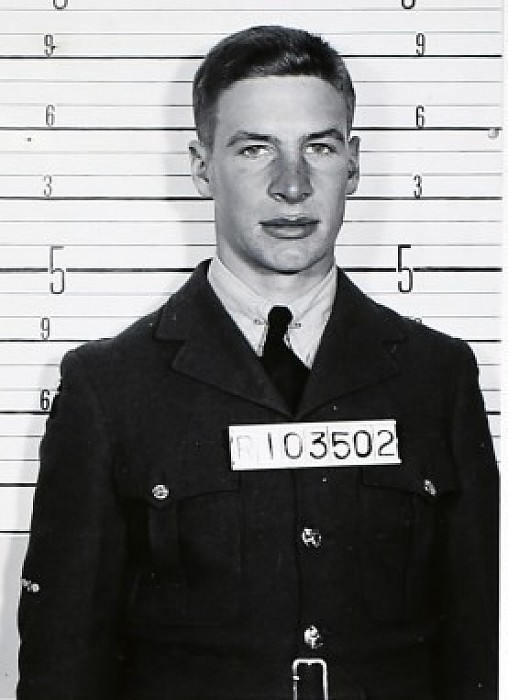
Gordon Robert Drimmie DFC - Captain and Pilot
Gordon Drimmie was born in Revelstoke, British Columbia, Canada 22nd April 1922.
Gordon was born in Revelstoke , British Columbia on 25 April 1922 where his father worked as a locomotive engineer for the Canadian Pacific Railway. He graduated from Revelstoke High School in 1940 and enlisted in the RCAF wanting to train as a pilot at Calagary, Alberta on 15 January 1941. It was noted in his application that he was an avid skier and also had a small workshop where he made model aircraft and other woodwork projects. Taken on strength at Brandon, Manitoba on 25 April 1941, he was posted to No. 2 Initial Training School, Regina on 22 June later that same year until he was posted to No.19 Elementary Flying Training School, Virden, Manitoba as LAC Drimmie to begin his training as a pilot. Upon successfully completing his training there, he was posted to the Service Flying Training School at Dauphin, Manitoba on 26 September where he graduated with his pilot's badge on 19 December 1941 and promoted to the rank of sergeant. Posted overseas he arrived in the UK on 10 February 1942 and spent two months training at No.3 PRC Bournemouth before being sent to No 2 Pilot Advanced Flying Unit at RAF Syerston for training on the twin engine Airspeed Oxford. Drimmie’s training on bombers began at RAF Upwood where he transitioned to the by then obsolete Blenheim light bomber before being posted to No.88 Squadron at RAF Oulton on 1 September 1942. Piloting a Douglas Boston with 88 Squadron, Drimmie participated in his first sortie, a minor raid on the airfield at St.Omer, on 1 November 1942. Appointed a commission, P/O Drimmie's next operation would be as part of a 93 aircraft force to bomb the Phillips electrical factory at Eindhoven on 6 December. Following which, he participated in five more daylight raids against targets along the French coast at Cherbourg, St.Omer, St.Malo and Dunkirk in January and February 1943, Gordon was next posted to No. 22 OTU at RAF Wellesbourne Mountford for training on the Vickers Wellington bomber on 29 May 1943.
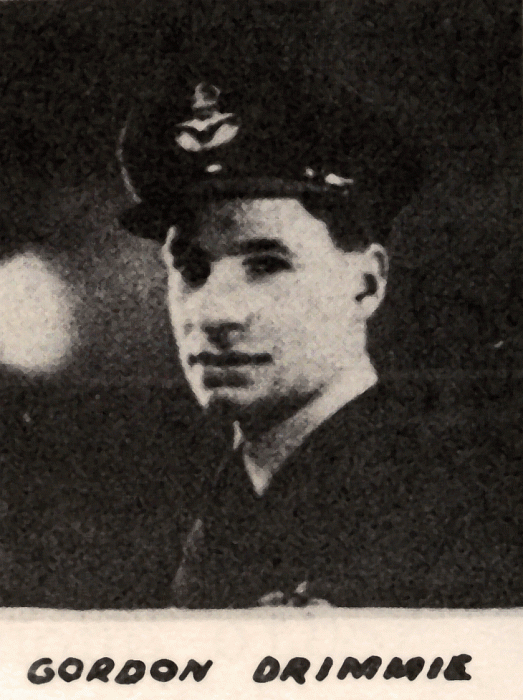
Promoted to the rank of Flying Officer, he was next posted to 1659 Conversion Unit to train on the Lancaster and Halifax types at RAF Topcliffe on 7 July and then to 428 Squadron at Middleton St.George, on 28 July 1943. His first major raid was made on the night of 30/31 July 1943 upon the town of Remscheid when he flew as second pilot with F/Lt. Gordon Fanson. During the month of August spent with 428 Squadron equipped with the Halifax heavy bomber, he and his crew flew a further eight operations against the enemy cities of Hamburg, Mannheim, Nuremberg twice, Milan, Leverkusen and Berlin as well as the first raid upon the V2 development site at Peenemunde in France. After only one month with 428 Squadron, Captain Drimmie and crew were selected to become Pathfinders with 405 Squadron based at Gransden Lodge. Their first operation, now flying the Lancaster, was on the night of 22/23 September 1943 to the city of Hannover. During the balance of 1943, they took part in a further 13 operations. A second trip in September took them to Mannheim and four raids in October were completed targeting Frankfurt, Hannover, Leipzig and Kassel. November commenced with a trip to Cologne followed up by an attack on the railway yards at Modane in France on the night of the tenth. The month of November 1943 also saw the start of Bomber Command's all-out assault on Berlin when in the following four and a half months Sir Arthur Harris launched sixteen major raids on that city alone. Of these Drimmie and crew participated in three consecutive attacks in November and one in December which was bracketed by trips to Leipzig and Frankfurt. Sadly on the crew's first operation of 1944, a raid on Brunswick, their aircraft failed to return. One month after being lost flying his 32nd sortie, Gordon Drimmie was awarded his Distinguished Flying Cross.
Public Records Office Air 2/8782 has recommendation dated 22 December 1943 when he had flown 31 sorties:
"This pilot has displayed coolness and devotion to duty of a very high order during the many operational sorties he has carried out with this squadron. He has set a high example to his crew and to the rest of the squadron. He has participated in attacks on most of the enemy\'s heavily defended targets including Leipzig, Frankfurt, Mannheim and Berlin. This officer is strongly recommended for the award of the Distinguished Flying Cross."
Gordon Drimmie was killed 14.1.1944 in Lancaster ND-423 on the mission to Braunschweig (Brunswick).
Drimmie Creek in the Upper Arrow Lakes draw down zone, British Columbia, Canada was named in 1950, as follows:
"Named to remember:
Royal Canadian Air Force Flying Officer Gordon Robert Drimmie, DFC,
service number J16306 from Revelstoke, British Columbia
serving with 405 Sqn when he was killed 14 January 1944, age 21.
Buried at Hanover Cemetery, Germany, grave 11.H.2.
Survived by parents Martin and Margaret Drimmie, Vancouver."
There is extensive information on Gordon Drimmie held by the Government of Canada Library and Archives site.
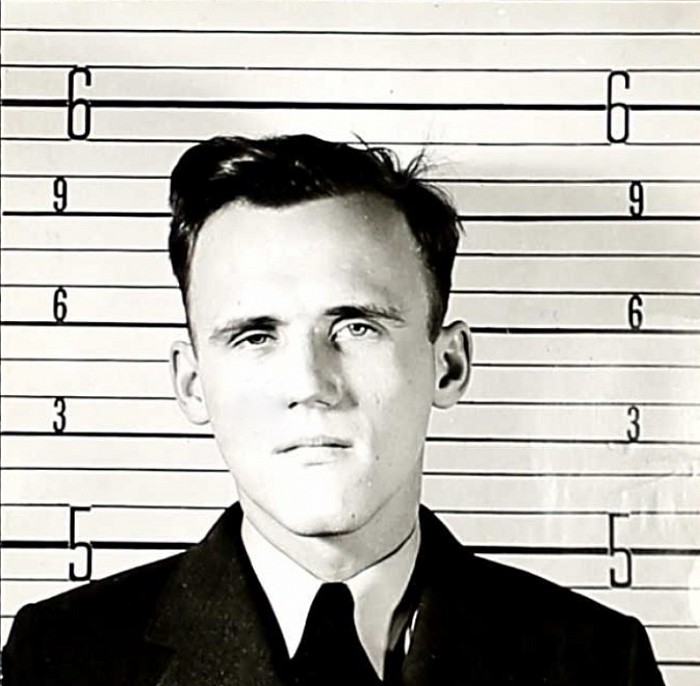
James Gilbey - Bomb Aimer
James Gilbey J17444 was born in 1921 to John F Gilbey and Annie E Gilbey (nee Walker) of Montreal, Quebec, Canada.
James was born and educated in Montreal and at the time of his enlistment in June 1941 he was working as a telephone installer for the Bell Telephone Company. Upon the completion of his initial training at No.1 ITS, Toronto he was found medically fit for aircrew category A3B and recommended suitable for training as an observer. Posted to No.9 Air Observers School, St.Jean, Quebec on 27 October 1941 he completed the course there at the end of January 1942 and was passed to No.6 Bombing and Gunnery School, Mountain View, Ontario where he was awarded his Observers badge and promoted to the rank of Sergeant 14 March 1942. To complete his navigation training, James was posted to No.2 ANS at Pennfield Ridge, N.B. for the advanced air observers course of instruction graduating from there one month later. Posted overseas he arrived at No. 3 PRC Bournemouth 12 May 1942 and then to No.3 (O) AFU at RAF Halfpenny Green where he spent one month training before being posted to No.23 OTU at RAF Pershore for training as a member of a night bomber crew re-mustering as an Air Bomber/Navigator 'B'. Posted to 405 Squadron 20 October 1942, Gilbey's name first appears in the squadron ORB on operations 22/23 March 1943, a raid on St.Nazaire as part of the F/Sgt. Armstrong crew. This was followed by three sorties with F/O College's crew on 16/17 April to Duisberg, 30 April/ 1 May Essen and 4/5 May to Dortmund. It was also during this time at 405 that James was appointed to a commission. After three weeks attached to 427 Squadron, he was posted to No.22 OTU at Wellesbourne Mountford attending an abbreviated course for experienced crew members prior to conversion to heavy bombers with 6 Group. It was here that Gilbey first crewed up with fellow Canadians Drimmie and Peterson. Three weeks at No.1659 Conversion Unit prepared the crew for operations flying the Halifax and Lancaster and on 28 July 1943 the crew were posted to 428 Squadron and subsequently to 405 Squadron.
James Gilbey was killed 14.1.1944 in Lancaster ND-423 on the mission to Braunschweig (Brunswick).
There is extensive information on James Gilbey held by the Government of Canada Library and Archives site.
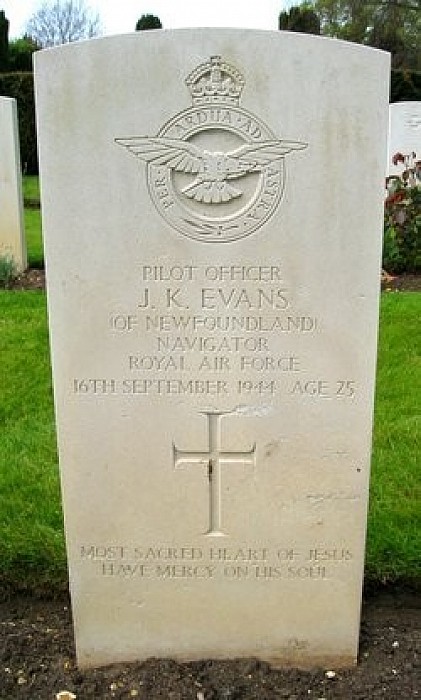
John Kevin Evans - Navigator
John Kevin Evans was born in 1919 to Michael Joseph and Anne Evans of St John's, Newfoundland.
He left 405 Squadron for PFF Mosquitos and was replaced by Rodger Jarvie for the 3rd/4th December Leipzig operation.
Evans was killed in a Mosquito B.20 (KB211) on 16th September 1944. He is buried in Cambridge, England.
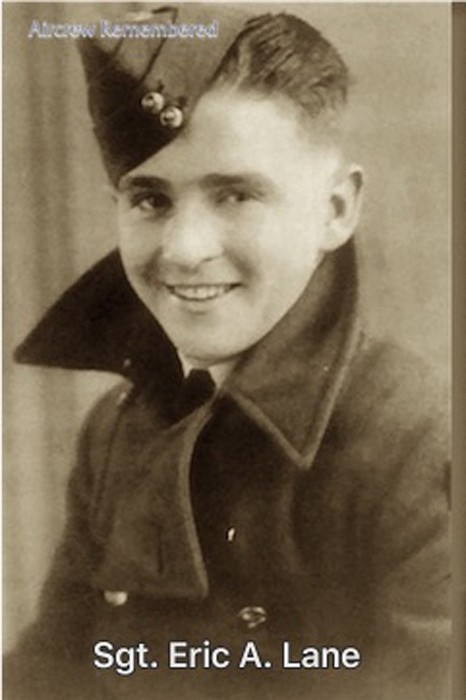
Eric Lane - Flight Engineer
Eric 'Ginger' Lane was born in Monmouth, Monmouthshire, Wales, January 1922 to George Henry and Blanche (née Kirby) Lane of Lydbrook, Gloucestershire, England. He was the regular flight engineer with the Drimmie crew having joined them at 428 Squadron when they converted over to the Halifax bomber.
Eric Lane was killed 14.1.1944 in Lancaster ND-423 on the mission to Braunschweig (Brunswick).
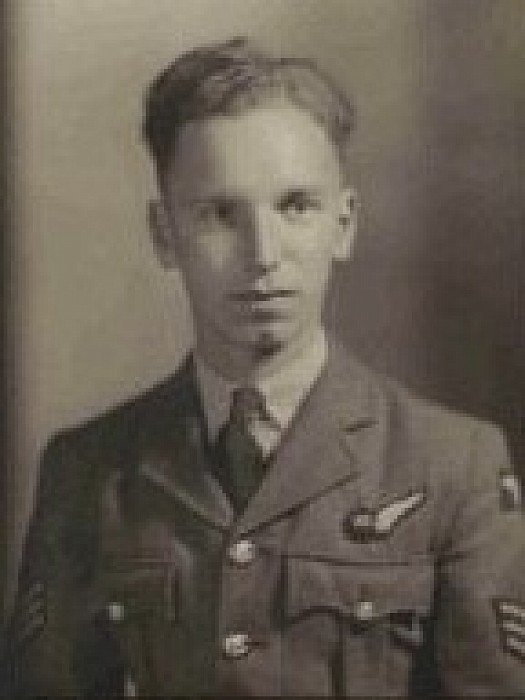
Allan Hazlehurst
Wireless Operator/Air Gunner Alan Hazlehurst was born in 1922 to Arthur John and Olive Hazlehurst, of Long Eaton, Derbyshire.
He missed the mission to Brunswick on 14th January 1944, being replaced by J J Waddell but was sadly killed two weeks later in Lancaster ND-462 near Berlin. He is buried in Berlin 1939-1945 War Cemetery.
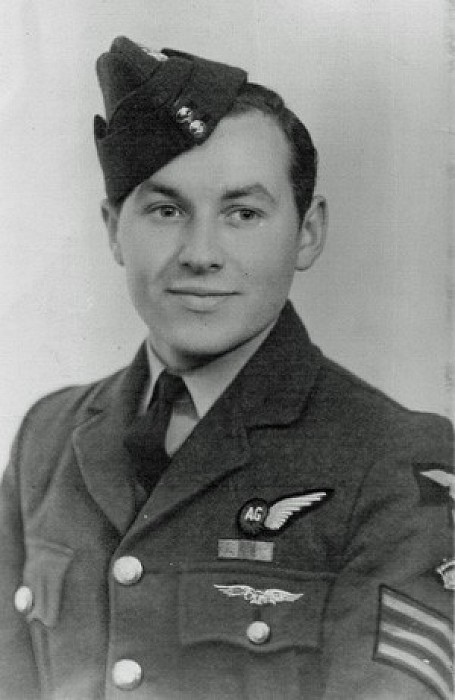
Dennis Frederick Smith - Rear Gunner
Dennis Frederick Smith was born in Sparkhill, Birmingham 27th May 1922. The family lived at 203 Knowle Road.
The family later moved to 1585 Stratford Road, Hall Green, Birmingham where Dennis eventually started his 'Animal Clinic – Dispensary and Surgery for Veterinary Treatment - D F Smith, Canine Specialist'.
He was called up to join the RAF, commencing training in September 1942 at Air Gunnery School (AGS) Morpeth in Northumberland. This was followed by training with 180 Squadron, mainly gunnery training in Mitchell aircraft but including map reading, air sea rescue and bombing exercises.
In June 1943 he was posted to No:22 Operational Training Unit (Wellesbourne and Gaydon) training as a rear gunner.
This was followed in July 1943 by two weeks at RCAF Topcliffe where the future crew was to come together.
Dennis joined 428 Squadron RCAF at Middleton St George 2nd August 1943. He and the crew were transferred to 405 Squadron RCAF in September 1943 after a couple of days at Upwood and Warboys, Cambridgeshire for additional training for the highly specialised Pathfinder duties they were about to undertake.
Dennis Smith was killed 14.1.1944 in Lancaster ND-423 on a mission to Braunschweig (Brunswick).
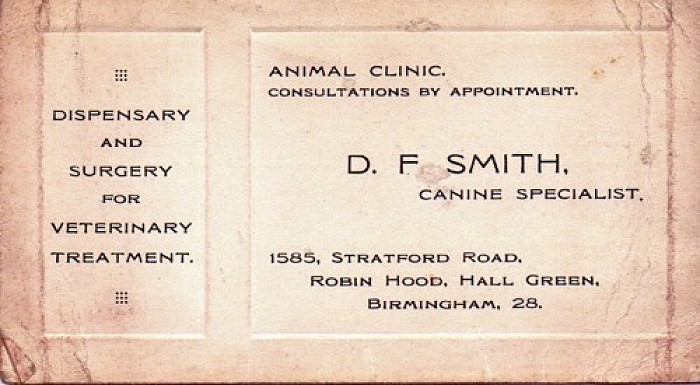
Dennis Smith's veterinary business card
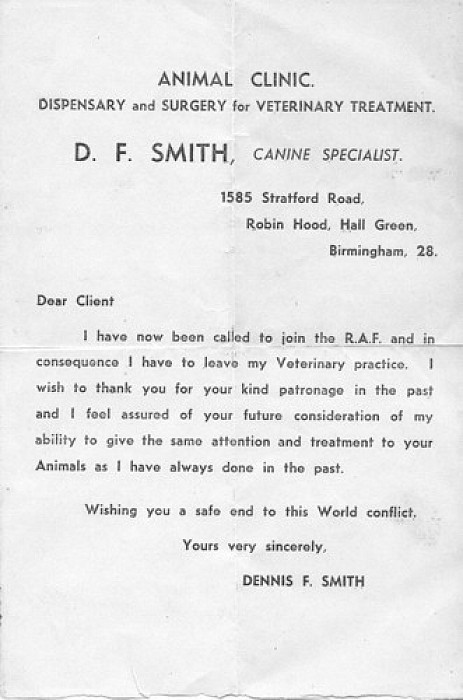
Dennis Smith's letter to customers
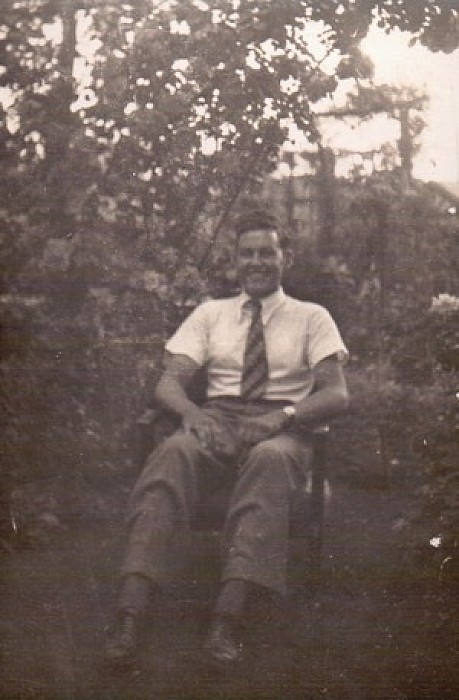
Dennis Smith before joining the RAF
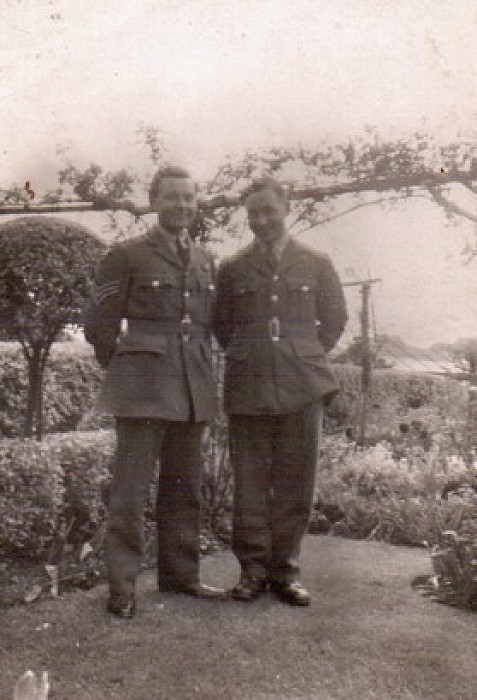
Dennis and Ron Smith in uniform
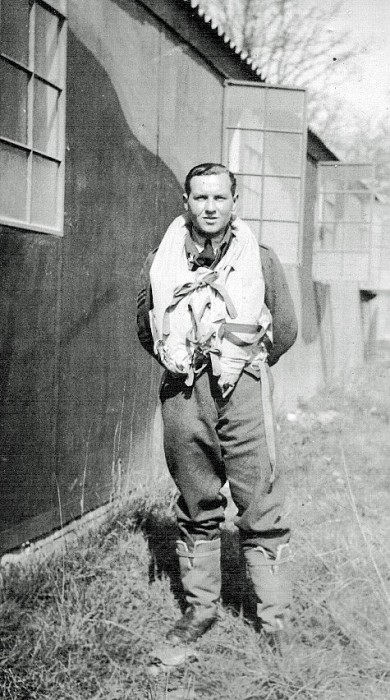
Dennis Smith in flying kit
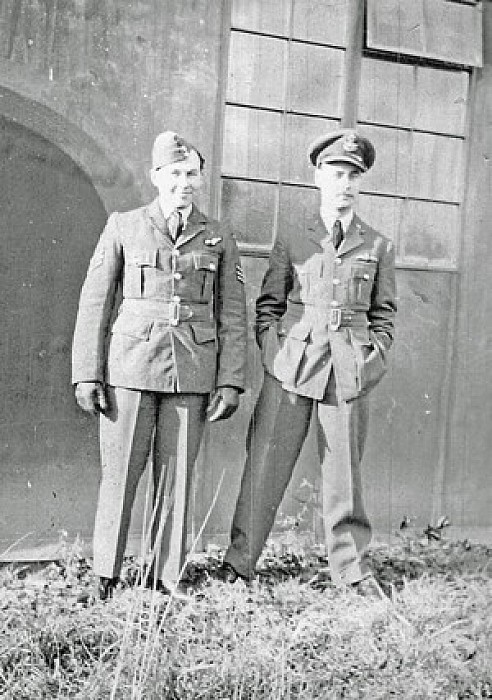
Dennis Smith with unknown officer
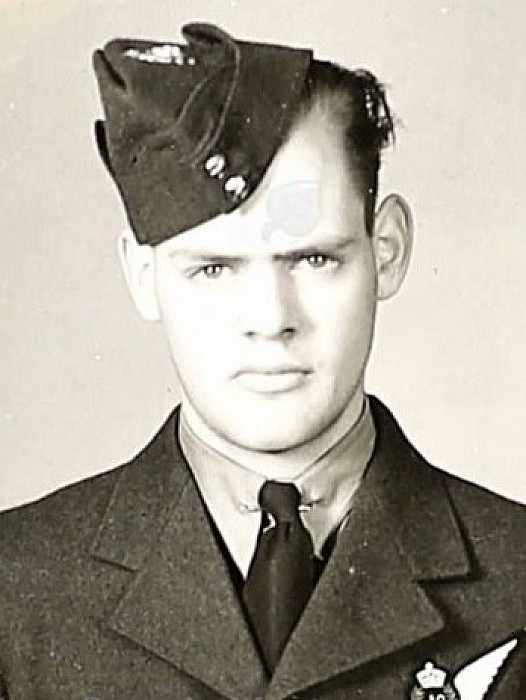
Raymond Peterson 1168827
Raymond Peterson - Mid-Upper Gunner
Raymond Floyd Paterson was born on the 25th June 1921 in Bentley, Lacombe, Alberta. Son of Leslie Raymond and Mildred Frances (née Carritt) Peterson from Bentley, Lacombe, Alberta, Canada.
After completing his initial training at Saskatoon in December 1942, he was selected as suitable for aircrew and posted to No. 3 Bombing & Gunnery School, MacDonald, Manitoba, for training as an air gunner. Graduating with his Air Gunner's badge on 2 April 1943 with the rank of Sergeant, he was posted overseas one month later arriving at No.3 PRC Bournemouth on 12 May. Posted to No.22 OTU at RAF Wellesbourne Mountford 18 May and then to 1659 Conversion Unit on 7 July. Posted to 428 Squadron 28 July and then to 405 Squadron 30 August 1943. Raymond first crewed up with Gordon Drimmie at 22 OTU and remained as part of that team throughout their operations with 405 and 428 Squadrons.
Raymond Peterson was killed 14.1.1944 in Lancaster ND-423 on a mission to Braunschweig (Brunswick).
There is extensive information on Raymond Peterson held on the Government of Canada Library and Archives site.
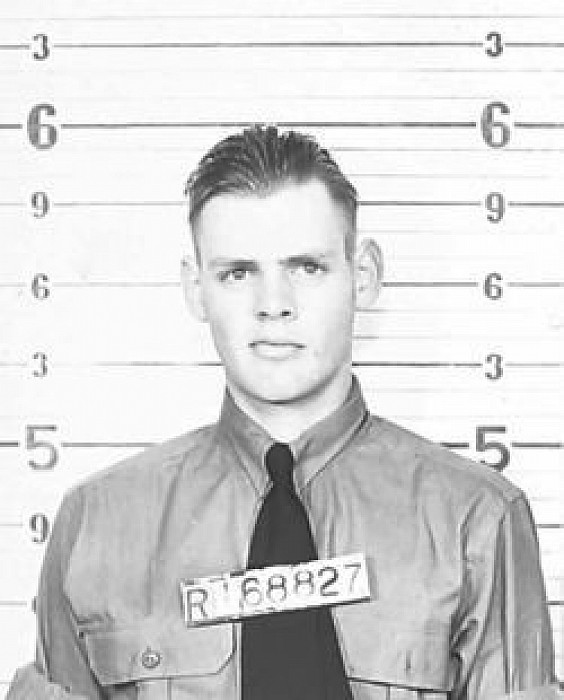
Raymond Peterson